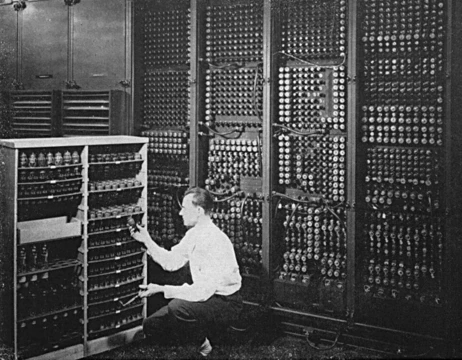
Assembly language
Low-level language with strong correspondence to machine code.

Assembly language, also known as assembler language or symbolic machine code, is a low-level programming language with a strong correspondence between its instructions and a computer architecture's machine code instructions. It is specific to a particular computer architecture, such as x86 or ARM, and is converted into executable machine code by a utility program called an assembler.
- field
- Computing
- known_for
- Low-level programming language with one statement per machine code instruction
- first_known_work
- Coding for A.R.C. (1947) by Kathleen and Andrew Donald Booth
- term_coined
- Assembler, by Wilkes, Wheeler and Gill in their 1951 book
Lore & Background
A macro assembler includes a macroinstruction facility. A cross assembler runs on a host system different from the target system. A high-level assembler provides language abstractions like advanced control structures and abstract data types. A microassembler helps prepare a microprogram. A meta-assembler accepts the syntactic and semantic description of an assembly language and generates an assembler for that language. Inline assembler is assembler code contained within a high-level language program.
Reader's Guide
Assembly language was commonplace for both systems programming and application programming in the first decades of computing. While still irreplaceable for some purposes, the majority of programming is now conducted in higher-level interpreted and compiled languages. Fred Brooks summarized the effects of the switch away from assembly language programming: 'Surely the most powerful stroke for software productivity, reliability, and simplicity has been the progressive use of high-level languages for programming. Most observers credit that development with at least a factor of five in productivity, and with concomitant gains in reliability, simplicity, and comprehensibility.' Today, it is typical to use small amounts of assembly language code within larger systems implemented in a higher-level language, for performance reasons or to interact directly with hardware. For instance, just under 2% of version 4.9 of the Linux kernel source code is written in assembly; more than 97% is written in C.
Did You Know?
- The first assembly code is found in Kathleen and Andrew Donald Booth's 1947 work, Coding for A.R.C.
- The term 'assembler' is generally attributed to Wilkes, Wheeler and Gill in their 1951 book.
- Assembly languages are architecture-specific, and system call mechanisms (e.g., INT or SYSCALL) are tied to particular operating systems, so code written for one OS typically does not work on another without modification
- A cross assembler runs on a host system different from the target system, facilitating development for embedded systems or microcontrollers.
Origins and the Birth of a Discipline
The earliest known instance of assembly code appears in the 1947 publication Coding for A.R.C., authored by Kathleen and Andrew Donald Booth, marking the moment when a symbolic language was first used to stand in for raw machine instructions. A few years later, in 1951, Wilkes, Wheeler, and Gill published The Preparation of Programs for an Electronic Digital Computer, a work generally credited with coining the term assembler. Interestingly, their original usage differed somewhat from the modern one: they described an assembler as a program that gathers several separate sections of code into a single unified program. The act of converting symbolic source into executable machine code came to be called assembly, and the computational step during which an assembler processes a program is known as assembly time. During computing's first decades, this was not a niche skill. Both the operating systems themselves and everyday application software were written entirely in assembly, making fluency in the language a prerequisite for virtually any serious programmer of the era.
Mnemonics, Layout, and the Pursuit of Readability
Assembly language replaces cryptic binary opcodes with human-readable mnemonic symbols that stand for specific machine instructions, architectural registers, flags, and directives. Some of these mnemonics are built into the assembler, while others can be defined by the programmer. Most instructions require one or more operands to be complete, and assemblers typically allow named constants, symbolic labels for memory locations, and even the evaluation of arithmetic expressions on operands. This capability spares developers from performing tedious manual calculations and makes assembly programs far more legible than their raw machine-code counterparts. The physical layout of source code has evolved considerably. In the punched-card era of the 1950s and early 1960s, column-oriented syntax was the norm, with each field occupying a fixed column. By the 1960s, free-form syntax using whitespace or punctuation as delimiters, as well as hybrid approaches that pinned labels to a specific column while leaving other fields flexible, became the more common convention. Many assemblers also provide macro facilities, debugging aids, and additional mechanisms to streamline the development workflow.
Tied to the Silicon: Architecture, Portability, and Cross-Assembling
Because assembly instructions map almost one-to-one onto the machine code of a particular processor, every assembly language is inherently bound to a specific computer architecture, whether that be x86 or ARM. There is no universal assembly dialect; instead, multiple assemblers may exist for the same architecture, and some assemblers are tailored to a particular operating system. Yet most assembly languages deliberately omit dedicated syntax for operating-system calls, since they expose the full raw capability of the processor, upon which every system-call mechanism ultimately depends. This makes them usable across any operating system without modification. High-level languages, by contrast, are generally portable across architectures but must undergo the far more complex processes of interpretation or compilation. A particularly important variant is the cross assembler, which runs on a host machine of a different type from the target system. This is essential when developing for resource-constrained platforms such as embedded systems or microcontrollers, where the resulting object code must be transferred via ROM, EPROM, a hardware programmer, or a data link using formats like Intel hex or Motorola S-record.
From Dominance to Niche: The Enduring Role of Assembly
In the earliest decades of computing, assembly was not merely common; it was the default medium for both systems programming and application development. That era has long since passed. Fred Brooks, in his influential essay No Silver Bullet, identified the progressive adoption of high-level languages as the single most powerful advance for software productivity, reliability, and simplicity, noting that most observers credit the shift with at least a fivefold gain in productivity alongside improvements in comprehensibility. Today, the majority of software is written in interpreted or compiled high-level languages. Assembly has not vanished, however. It remains irreplaceable in certain contexts, and it is typical to find small pockets of assembly embedded within larger systems, either to squeeze out performance gains or to interact directly with hardware in ways the surrounding language cannot express. A concrete illustration comes from the Linux kernel: in version 4.9, just under two percent of the source code is written in assembly, while more than ninety-seven percent is written in C.
Frequently Asked Questions
Who is Assembly language?
Assembly language is a low-level programming language in which each written statement corresponds one-to-one with a single instruction understood by a specific CPU architecture, such as x86 or ARM. It is not universal across machines; instead, it is tightly bound to the hardware it targets and requires a separate utility called an assembler to produce runnable binary.
What are Assembly language's powers and role?
Its defining strength is giving a programmer direct, symbolic control over every processor operation without having to spell out raw binary digits. Because of that tight coupling to hardware, it is the go-to tool when even a single clock cycle matters, such as in device drivers, bootloaders, or performance-critical routines.
How does Assembly language's story end?
In the build pipeline, Assembly language's arc concludes the moment an assembler program reads its mnemonic instructions and emits the corresponding machine-code bytes. From that point onward the assembler's work is finished, and the resulting object file is handed off to a linker to become part of a final executable.
Why is Assembly language important?
It was among the very first ways humans could give a computer structured instructions, with the earliest known example being code written for the A.R.C. machine by Kathleen and Andrew Donald Booth in 1947. Even decades later it remains indispensable for understanding how hardware actually executes code and for squeezing out the last bit of performance that higher-level languages cannot reach.
What is Assembly language's origin story?
The practice of writing symbolic, human-readable stand-ins for machine instructions predates the formal term, as the Booths were already coding the A.R.C. in 1947. The name "assembler" itself was coined by Wilkes, Wheeler, and Gill in their 1951 book, which helped cement the language's identity and the role of the translation tool that bears its name.
More in Computing & Digital 1-24
Spotted an error? Know more?
This is a living reference — every entry is fact-audited, and reader corrections feed straight into our audit queue. Suggest an edit · See this site's audit record