Central processing unit
Primary processor executing computer program instructions.

A central processing unit (CPU), also known as a central processor, main processor, or simply processor, is the primary processor in a given computer. Its electronic circuitry executes instructions of a computer program, such as arithmetic, logic, controlling, and input/output (I/O) operations. The form, design, and implementation of CPUs have changed over time, but their fundamental operation remains almost unchanged.
- First use of term
- 1955
- Key components
- Arithmetic-logic unit (ALU), processor registers, control unit
- Early stored-program computer
- Manchester Baby (first program 21 June 1948)
- Notable early architecture
- von Neumann architecture (EDVAC design)
- Common implementation
- Integrated circuit (IC) microprocessors
- Modern variant
- Multi-core processors (MCPs)
Lore & Background
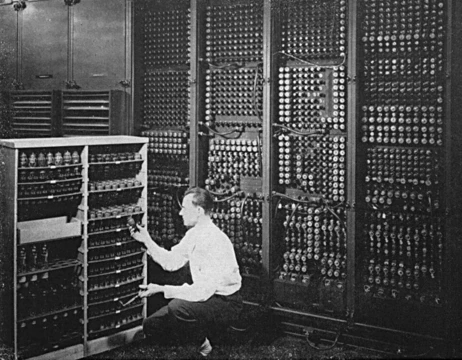
Early computers such as the ENIAC had to be physically rewired to perform different tasks, which caused these machines to be called 'fixed-program computers.' The term 'central processing unit' has been in use since as early as 1955. The idea of a stored-program computer was present in the design of ENIAC but initially omitted; mathematician John von Neumann distributed a paper on the EDVAC on June 30, 1945, outlining a stored-program computer that was not fully operational until 1951. The Manchester Baby ran its first program on 21 June 1948, and the Manchester Mark 1 ran its first program during the night of 16–17 June 1949. Early CPUs were custom designs, but standardization began in the era of discrete transistor mainframes and minicomputers, accelerating with the integrated circuit. Prior to transistors, relays and vacuum tubes were used; vacuum-tube computers like ENIAC averaged eight hours between failures, while relay computers were generally less reliable due to mechanical wear. Transistorized CPUs in the 1950s and 1960s offered increased reliability, lower power consumption, and higher speeds.
Reader's Guide
The central processing unit is the core component enabling software execution in computers, a role that has remained fundamentally unchanged despite dramatic technological evolution. From physically rewired machines like ENIAC to stored-program designs pioneered by von Neumann and others, the CPU transitioned from vacuum tubes to transistors, then to integrated circuits, allowing miniaturization and standardization. This shift from custom designs to mass-produced multi-purpose processors has embedded digital devices into nearly every aspect of modern life, from automobiles to cellphones. The development of multi-core processors and systems on chip (SoCs) further expanded CPU capabilities, while architectural concepts like von Neumann and Harvard designs continue to influence modern computing. The CPU's significance lies in its universal function as the executor of instructions, enabling the versatility and ubiquity of digital technology.
Did You Know?
- The term 'central processing unit' has been in use since as early as 1955.
- The Manchester Baby, a small-scale experimental stored-program computer, ran its first program on 21 June 1948.
- Vacuum-tube computers such as ENIAC tended to average eight hours between failures.
Frequently Asked Questions
Who is Central processing unit?
The CPU is the primary processor inside a computer, responsible for executing the instructions of a running program. It handles arithmetic, logic, control flow, and input/output operations through its internal circuitry. The term 'central processing unit' first appeared in 1955.
What are Central processing unit's powers/role?
A CPU's core job is to fetch and execute program instructions, performing calculations, making logical decisions, and coordinating data flow. It does this through three key internal parts: an arithmetic-logic unit, a set of registers, and a control unit. Essentially, it is the component that turns software into action.
How does Central processing unit's story end?
The CPU hasn't reached an ending—its fundamental operation of executing instructions has stayed remarkably stable since the early stored-program machines like the Manchester Baby in 1948. Modern CPUs have evolved into multi-core processors, but the core principle of fetching and executing instructions remains unchanged.
Why is Central processing unit important?
Without a CPU, a computer cannot run any program, since it is the component that actually interprets and carries out every instruction. Its design, rooted in the von Neumann architecture from the EDVAC era, underpins virtually all digital computing to this day.
What are Central processing unit's key components?
A CPU is built around three main parts: the arithmetic-logic unit (ALU) for calculations, processor registers for fast temporary storage, and a control unit that directs the flow of operations. In modern systems, these components are typically fabricated together as an integrated circuit microprocessor.
More in Computing & Digital 1-24
Spotted an error? Know more?
This is a living reference — every entry is fact-audited, and reader corrections feed straight into our audit queue. Suggest an edit · See this site's audit record