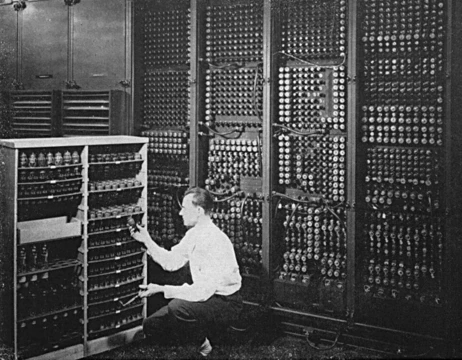
Computer hardware
Physical parts of a computer directed by software.

Computer hardware comprises the physical components of a computer, including the central processing unit (CPU), random-access memory (RAM), motherboard, data storage, graphics card, sound card, and computer case, as well as external devices such as monitors, mice, keyboards, and speakers. Hardware is directed by software—a set of written instructions—to execute commands, and the combination of hardware and software forms a usable computing system. The term 'hardware' derives from its rigidity compared to easily changed software.
- field
- Computer hardware
- known_for
- Physical components of computing systems, including CPU, RAM, motherboard, storage, and peripherals
Lore & Background
In the 19th century, Charles Babbage designed the difference engine and a general-purpose computer that was never built, but his design influenced later computers with punch cards, memory, an arithmetic unit, and a primitive programming language. In 1936, Alan Turing developed the concept of the universal Turing machine, a stored-program computer model that could mimic any Turing machine based on software instructions. Boolean algebra, invented by George Boole in the mid-19th century, became the basis for circuits in modern hardware. In 1945, John von Neumann devised the von Neumann architecture, featuring centralized memory for data and programs, a CPU, and input/output units, though its single bus created the von Neumann bottleneck.
Reader's Guide
Computer hardware is significant as the tangible foundation of all computing systems, enabling the execution of software instructions. Its development from mechanical calculators to electronic computers was driven by advances in relays, vacuum tubes, and integrated circuits. The von Neumann architecture, introduced in 1945, became the template for most modern computers, though its design introduced performance limitations. Instruction set architectures (ISAs), such as CISC and RISC, define the interface between hardware and software; RISC, invented in the 1980s, displaced CISC in many applications due to its simplicity and efficiency. Cooling and power delivery have become critical constraints, as processors generate heat that can throttle performance or damage components, leading to air and liquid cooling solutions. The personal computer remains a common type due to its versatility and relatively low price.
Did You Know?
- The term 'hardware' derives from the fact that it is hard or rigid with respect to changes, unlike software which is easy to change.
- John von Neumann's architecture featured a single bus to transfer data, creating the von Neumann bottleneck when the system fetches both data and programs simultaneously.
From Abacus to Microprocessor: The Long Arc of Computing Hardware
The journey of computing hardware stretches back thousands of years. The earliest aids were simple tally sticks and clay spheres used in the Fertile Crescent to track livestock or grain. The abacus, descended from Babylonian devices dating to around 2400 BCE, became a staple for arithmetic across civilizations. In medieval Europe, merchants used checkered cloths and movable markers to manage financial calculations. The Antikythera mechanism, recovered from a shipwreck near a Greek island and dated to roughly 100 BCE, stands as the earliest known mechanical analog computer, designed for astronomical calculations. No device of comparable complexity emerged again until the fourteenth century. The Industrial Revolution brought mechanical loom-guiding devices, and the early twentieth century saw specialized analog electrical machines. Then came the rapid digital succession: electromechanical systems in the 1930s, thermionic valves also in the 1930s, semiconductor transistors in the 1940s, MOS transistors in the 1950s, and monolithic integrated circuits from the 1950s onward. Each step shrank the hardware and boosted efficiency, culminating in the microprocessor and the microcomputer revolution of the 1970s.
The Word "Computer" and the People Behind It
The term "computer" carries a history far removed from silicon and circuitry. The Oxford English Dictionary traces the first known use to a 1613 book by Richard Brathwait, where "computer" described a person skilled in reckoning. The Online Etymology Dictionary places the earliest attested use in the 1640s as an agent noun derived from "compute," meaning one who calculates. For centuries the word referred exclusively to human beings performing arithmetic. During the latter half of the nineteenth and into the mid-twentieth century, this human role carried a stark economic reality: women were frequently hired for these positions because they could be compensated less than men. By 1943, the majority of human computers were women. The shift in meaning came gradually. The Online Etymology Dictionary records the first use of "computer" to describe a calculating machine of any type in 1897, and the modern sense—a programmable digital electronic device—emerging in 1945, with a theoretical precursor dating to 1937 in the concept of the Turing machine. Thus, a word once tied to human labor and gendered economics now labels the machines that have largely replaced that labor.
Anatomy of a Modern Computer System
At its core, a modern computer assembles a relatively small set of hardware components into a functional whole. The central processing unit, typically realized as a microprocessor, handles arithmetic and logical operations. A sequencing and control unit, working in tandem with the CPU, can alter the order of operations based on stored information, giving the machine its programmable flexibility. Semiconductor memory chips provide the workspace where data and instructions reside during processing. Beyond this internal architecture, peripheral devices extend the computer's reach into the physical world. Input devices such as keyboards, mice, and joysticks feed information into the system, while output devices like monitors and printers deliver results. Some peripherals, such as touchscreens, serve both roles simultaneously. Together these components allow information to be retrieved from external sources, processed, saved, and retrieved again. The broader term "computer system" can encompass this nominally complete unit—hardware, operating system, software, and peripherals—or it can describe a collection of linked machines functioning as a network or cluster.
Ubiquity, Scale, and the Digital Revolution
What began as a handful of machines in the 1930s has become an invisible infrastructure woven into nearly every aspect of modern life. Today's computing hardware spans an extraordinary range: from single-purpose controllers embedded in key fobs, microwave ovens, and remote controls, to industrial robots operating inside factories, to supercomputers pushing the boundaries of raw processing power. General-purpose devices like personal computers and smartphones sit at the center of this spectrum, while the Internet links billions of computers and users into a single interconnected fabric. The driving force behind this expansion has been a relentless increase in transistor density. Moore's observation that transistor counts doubled roughly every two years set the pace for decades of shrinking, faster, and more versatile hardware. This trajectory powered the Digital Revolution across the late twentieth and early twenty-first centuries, transforming computing from a specialized industrial tool into the foundational control system for an enormous variety of consumer and industrial products.
Frequently Asked Questions
What is Computer hardware?
Computer hardware refers to every tangible, physical part that makes up a computing system, from the internal chips and boards to the peripherals you plug in and interact with daily.
What are the main components of Computer hardware?
The core internal pieces include the CPU, RAM, motherboard, storage drives, and graphics or sound cards, all housed inside the computer case. External hardware extends the system with monitors, keyboards, mice, and speakers.
How does Computer hardware work together with software?
Hardware on its own cannot act; it follows the written instructions provided by software to carry out specific tasks. Together, the physical components and the code running on them form a fully functional computing system.
Why is it called 'hardware' instead of just 'parts'?
The term comes from the idea of something rigid and fixed, in contrast to software, which can be easily rewritten or updated. Hardware represents the solid, unchanging physical layer beneath all the flexible digital instructions.
Why is Computer hardware important to the field of computing?
Without the physical substrate of hardware, no software could ever execute, store data, or display results to a user. It is the foundational layer that gives every digital process a real, working body.
More in Computing & Digital 1-24
Spotted an error? Know more?
This is a living reference — every entry is fact-audited, and reader corrections feed straight into our audit queue. Suggest an edit · See this site's audit record