Computer program
A sequence of instructions executed by a computer.

A computer program is a sequence or set of instructions in a programming language for a computer to execute. It is one component of software, which also includes documentation and other intangible components. A computer program in its human-readable form is called source code, which must be translated into machine instructions via a compiler or executed by an interpreter.
- early_example_language
- BASIC (1964)
- stored_program_concept
- February 1944 memo by Eckert and Mauchly
- von_Neumann_architecture
- First Draft of a Report on the EDVAC (June 30, 1945)
Lore & Background
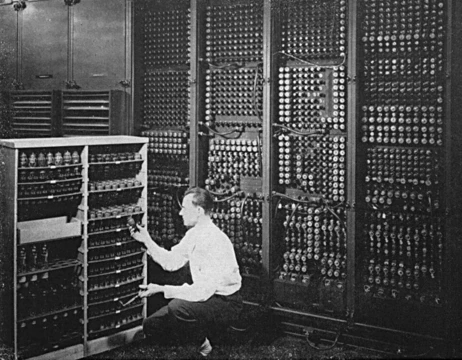
The device had a store for memory and a mill for processing, programmed using perforated cards. In 1936, Alan Turing introduced the Universal Turing machine, a theoretical finite-state machine with an infinitely long tape, which can model every computation; all present-day computers are Turing complete. Programming it took up to two months, involving function tables, plugboards, and switches. Debugging took a week.
Reader's Guide
The stored-program concept, introduced by Presper Eckert and John Mauchly in a February 1944 memo, allowed computers to load instructions into memory like data, enabling quick programming and fast calculations. John von Neumann published the First Draft of a Report on the EDVAC on June 30, 1945, equating computer structures with the human brain, leading to the von Neumann architecture deployed in the EDVAC and EDSAC in 1949. Improvements in software development are the result of improvements in computer hardware.
Did You Know?
- The Analytical Engine's store could hold 1,000 numbers of 50 decimal digits each.
- The Intel 4004 microprocessor was originally designed for a Japanese calculator company, Busicom.
More in Computing & Digital 1-24
Spotted an error? Know more?
This is a living reference — every entry is fact-audited, and reader corrections feed straight into our audit queue. Suggest an edit · See this site's audit record