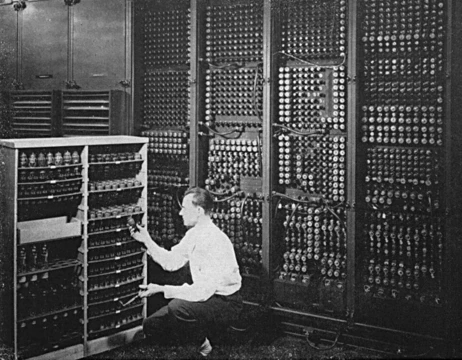
Computer programming
The composition of instructions for computers to follow.

Computer programming, also known as coding, is the composition of sequences of instructions called programs that computers follow to perform tasks. It involves designing and implementing algorithms by writing code in one or more programming languages, typically using high-level languages that are more intelligible to humans than machine code.
- field
- Computer science
- known_for
- Creation of programs that direct computers to perform tasks
Lore & Background
Programmable devices have existed for centuries. As early as the 9th century, a programmable music sequencer was invented by the Persian Banu Musa brothers, who described an automated mechanical flute player. Code-breaking algorithms also date to the 9th century, when Al-Kindi described cryptanalysis by frequency analysis. In the 1880s, Herman Hollerith invented machine-readable data storage, and later control panels allowed programming of tabulators. The stored-program computer concept introduced in 1949 allowed programs and data to be stored in the same memory. Machine code was the language of early programs, soon supplemented by assembly languages. The first compiler-related tool, the A-0 System, was developed in 1952 by Grace Hopper, who coined the term 'compiler'. FORTRAN, the first widely used high-level language with a functional implementation, appeared in 1957, followed by COBOL and Lisp. Programs were mostly entered via punched cards or paper tape until the late 1960s, when terminals and text editors became common.
Reader's Guide
Computer programming is significant as the fundamental activity that enables computers to perform tasks across all domains. Its history spans centuries of programmable devices, from mechanical automata to modern software. The development of high-level languages and compilers made programming more accessible and less tied to specific hardware, allowing for greater abstraction and portability. Key quality requirements for programs include reliability, robustness, usability, portability, maintainability, and efficiency. Readability of source code is crucial because programmers spend most of their time reading and modifying existing code rather than writing new code. The field continues to evolve, with automated tests and fitness functions helping to maintain quality attributes. Programming's legacy includes enabling everything from simple calculations to complex systems that underpin modern society, with its methods and tools constantly adapting to new challenges and technologies.
Did You Know?
- The first compiler-related tool, the A-0 System, was developed in 1952 by Grace Hopper, who also coined the term 'compiler'.
- In the 9th century, the Persian Banu Musa brothers described an automated mechanical flute player, an early programmable device.
- Readability of source code is important because programmers spend the majority of their time reading and modifying existing code, not writing new code.
More in Computing & Digital 1-24
Spotted an error? Know more?
This is a living reference — every entry is fact-audited, and reader corrections feed straight into our audit queue. Suggest an edit · See this site's audit record