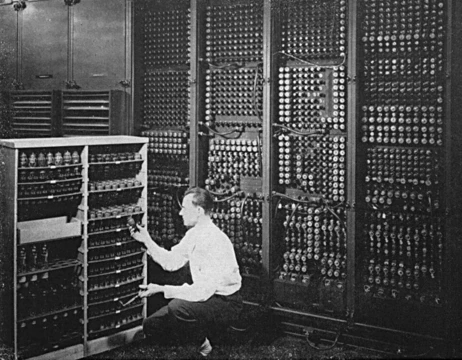
Computing
Goal-oriented activity involving computing machinery and algorithmic processes.

Computing is any goal-oriented activity that requires, benefits from, or creates computing machinery. It includes the study and experimentation of algorithmic processes, and the development of both hardware and software. Computing encompasses scientific, engineering, mathematical, technological, and social aspects. Major computing disciplines include computer engineering, computer science, cybersecurity, data science, information systems, information technology, and software engineering.
- field
- Computing
- known_for
- Goal-oriented activity involving computing machinery, algorithmic processes, and hardware/software development
Lore & Background
The history of computing predates the history of computing hardware and includes methods intended for pen and paper with or without the aid of tables. Computing is intimately tied to the representation of numbers, though mathematical concepts necessary for computing existed before numeral systems. Abaci of a more modern design are still used as calculation tools today. The first recorded proposal for using digital electronics in computing was the 1931 paper 'The Use of Thyratrons for High Speed Automatic Counting of Physical Phenomena' by C. E. Wynn-Williams. Claude Shannon's 1938 paper 'A Symbolic Analysis of Relay and Switching Circuits' introduced the idea of using electronics for Boolean algebraic operations. The concept of a field-effect transistor was proposed by Julius Edgar Lilienfeld in 1925. John Bardeen and Walter Brattain, working under William Shockley at Bell Labs, built the first working transistor in 1947. In 1953, the University of Manchester built the first transistorized computer, the Manchester Baby. In 1957, Frosch and Derick manufactured the first silicon dioxide field effect transistors at Bell Labs. A team demonstrated a working MOSFET at Bell Labs in 1960. The MOSFET made possible high-density integrated circuits, leading to the computer revolution or microcomputer revolution.
Reader's Guide
Computing is a broad field that encompasses the study and development of algorithmic processes, hardware, and software. Its history includes early tools like the abacus, the introduction of digital electronics for computing in the 1930s, and the development of the transistor in the 1940s and 1950s. The MOSFET, demonstrated in 1960, enabled high-density integrated circuits, which drove the computer revolution. Computing includes multiple disciplines such as computer engineering, computer science, cybersecurity, data science, information systems, information technology, and software engineering. It also covers computer hardware (physical parts like CPU, memory, input/output), computer software (programs and data), system software (operating systems, utilities, device drivers), application software (programs for specific tasks), computer networks (interconnected hardware for sharing resources), the Internet (global system using TCP/IP), and computer programming (writing, testing, debugging, and maintaining source code). The term computing is synonymous with counting and calculating, and earlier referred to actions performed by mechanical computing machines or human computers.
Did You Know?
- The first recorded proposal for using digital electronics in computing was the 1931 paper by C. E. Wynn-Williams.
- John Bardeen and Walter Brattain built the first working transistor in 1947 at Bell Labs.
- The MOSFET, demonstrated at Bell Labs in 1960, made possible high-density integrated circuits.
More in Computing & Digital 1-24
Spotted an error? Know more?
This is a living reference — every entry is fact-audited, and reader corrections feed straight into our audit queue. Suggest an edit · See this site's audit record